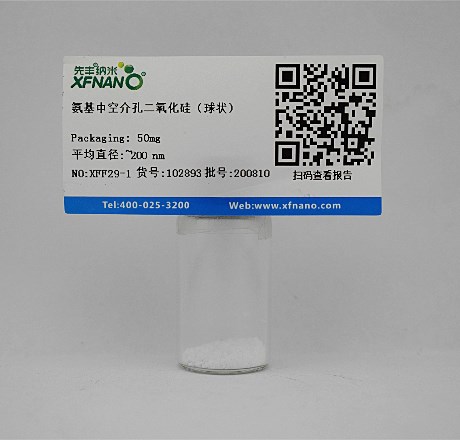


Aminated hollow mesoporous silica(globular)
NO.:102893 Code:XFF29-1
CAS:7631-86-9 Param:D:~200 nm
Paproductckage:50mg Expdate:365days
{{personLoading ? (english ? 'Finding your sales contact…' : '正在匹配服务人员…') : (english ? 'No QR code available. Please leave a message.' : '暂无可用二维码,请留言咨询。')}}

Product Name
Name :Aminated hollow mesoporous silica(globular)
Product Overview
As a common inorganic nanoparticle, silica nanoparticles have a series of advantages such as controllable morphology, orderly and adjustable pore structure, large specific surface area, easy modification of surface functional groups, and good biocompatibility, which make them widely used in biomedicine, catalysis, environmental protection, optics and other fields.
The main preparation method of silica nanoparticles is sol-gel method, and the silicon source is formed by hydrolysis polycondensation under catalysis. The method was first proposed by Stober in 1968. According to the morphology characteristics of silica nanoparticles, they can be roughly divided into three types: solid silica, mesoporous silica and hollow mesoporous silica. As a common mesoporous material, hollow mesoporous silica nanoparticles (HMSN) have good stability, low toxicity and high biocompatibility, due to their highly permeable mesoporous shell and internal cavity easy to load guest substances (such as organic small molecules, inorganic particles with optical properties or magnetic properties, protein macromolecules), in catalysis, drug controlled release, controlled synthesis. Energy storage and environmental protection have a wide range of application prospects.
The surface of silica nanoparticles is rich in silicon hydroxyl group, which is conducive to the chemical modification of the surface. By modifying different functional groups, silica nanoparticles can be given more functions. At present, the commonly used surface modification types are surface amination, carboxylation, sulfhydrylation, organic chain functionalization and so on. The surface modification of silica nanoparticles is mainly through the introduction of different types of silane coupling agents, such as 3-aminopropyl triethoxysilane (APTES), which can be used for amination modification, succinic anhydride can be used for carboxylation modification, and 3-mercaptopropyl trimethoxysilane can be used for sulfhydryl modification.
Technical Parameter
Form:white powder
Purity:≥ 99.9wt%
Product Features
1. Unique hollow structure: there is a hollow area inside, which can be used to load and encapsulate various substances.
2. Protective effect: It can protect the encapsulated substance from the influence of the external environment, such as light, heat, chemical substances, etc.
3. Good biocompatibility: When applied in the biomedical field, it usually has low toxicity and good biocompatibility.
4. Good chemical stability and thermal stability: can maintain structural stability in a wide temperature and chemical environment.
5. Surface modifiability: Its surface is easy to be chemically modified to meet different application needs.
Application Fields
1. Biomedical materials: The hollow mesoporous silica material not only has a loose shell with adjustable pore size, but also has an internal cavity with controllable size, which can be used as a carrier of the guest material, separate the guest material from the surrounding environment, and transport it to the appropriate location after release. Therefore, it can be used as a carrier for drug slow release/controlled release and enzyme immobilization.
2. Catalytic carrier: hollow mesoporous SiO2 material has regular pores, large specific surface area and good stability. Using hollow mesoporous SiO2 material as the carrier of supported catalysts (such as nano Au, Pt, Ag, etc.), its large specific surface area can improve the dispersion of the catalyst, while the catalyst nanoparticles highly dispersed in its pores are not easy to aggregate and grow, thus improving the stability of the nanoparticles in the reaction and improving the catalytic efficiency.
3. Adsorption material: Hollow mesoporous SiO2 material is stable and reusable due to its large pore volume, adjustable pore size and high specific surface area, and is an excellent carrier for adsorption materials. Its surface contains a large number of easily modified silicon hydroxyl groups, which can be prepared with selective adsorption and separation materials by introducing functional groups such as -NH2, -S- and -SH.
Related Information
Please e-mail for the detailed characterization data.
E-mail:sales@xfnano.com

新型中空结构的硅/碳(H-SiNS/C)纳米复合材料
2022年3月4日,Carbon报道了一种新型的中空结构的硅/碳(H-SiNS/C)纳米复合材料。在该复合材料中,大量微小的Si纳米颗粒被一个薄的介孔Si壳所包裹,而该介孔Si壳又被碳层所覆盖。在这个结构中,具有丰富内部空隙的介孔硅壳可以有效地适应体积变化,并缓解反复(脱)锂过程中的机械应力。碳层可以作为坚硬的物理机械支撑,进一步限制内部硅壳的膨胀/收缩,保证整个粒子结构的完整性。研究人员发现,由碳层构建的导电框架有利于电极的反应动力学以及硅的均匀体积变化,因此,H-SiNS/C纳米复合材料显示出高可逆容量(0.1 A g-1:~1670 mAh g-1)、优秀的速率能力(2 A g-1: >1150 mAh g-1)、高的平均库伦效率(∼99.8%)和卓越的循环稳定性。
 Delivery
The postage for Jiangsu, Zhejiang, Shanghai and Anhui is10yun,Other areas are20, Please consult for international shipping sales@xfnano.com。full purchase 500.0 yuan free shipping. If the stock shows 0, please call or email to confirm, toll free:400 025 3200 Email-:sale@xfnano.com Thanks for the support!
 Recommend